FREE
What's included?
90 questions (3 questions x 5 days x 6 weeks)
Editable PowerPoint
Teacher guide
Progression document
Answers
Aligned to White Rose version 3
FREE
First 6 weeks for free
PREMIUM
All 36 weeks with premium:
Rapid Reasoning | Weeks 1 to 6 | Year 6
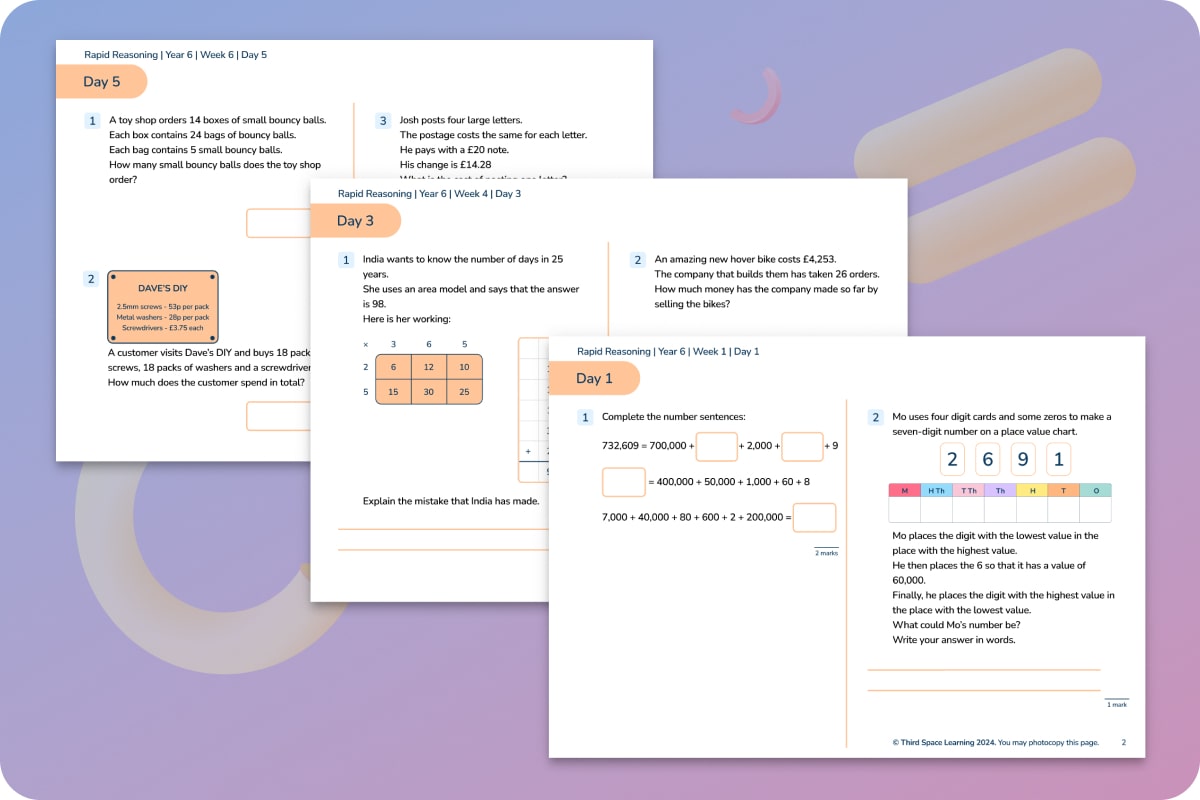
6 weeks of daily reasoning and problem solving questions for Year 6 (weeks 1 to 6). 90 questions to build skills and confidence at KS2; use with daily arithmetic practice from Fluent in Five.
Already have an account?
Develop your pupils’ confidence in problem solving and reasoning with daily Rapid Reasoning questions for weeks 1 to 6 of Year 6. With 90 questions spread across the 6 weeks you have 3 questions a day to show in an editable PowerPoint presentation. They follow a clear progression in terms of both content domain and cognitive demand and will introduce pupils to a wide variety of reasoning and problem solving question types.
This daily practice resource is designed to help overcome pupils’ barriers to reasoning and problem solving in KS2 and to develop confidence in tackling the varied and complex questions that they may encounter in their KS2 SATs.
Like all Third Space Learning resources, Rapid Reasoning follows a maths mastery approach. Pupils are encouraged to develop depth in a single topic over the course of a week to allow them to build up their knowledge gradually.
Rapid Reasoning was created as a partner resource to the very popular Fluent in Five. Regular daily practice of 10 to 20 minutes, when possible, will help you to achieve the best results.
The resource also includes support in teaching problem solving and reasoning as well as worked examples to help scaffold and develop pupils’ skills.
Suitable to use with mastery schemes such as White Rose.
Full 36 week set available with premium
Topic breakdown per week
Week 1: Focuses on exploring, reading, and writing numbers up to 10 million, working with powers of 10, and using number lines up to 10 million.
Week 2: Concentrates on comparing and ordering whole numbers up to 10 million, rounding numbers up to 10 million, using negative numbers in context, and calculating intervals across zero.
Week 3: Covers adding and subtracting integers, identifying common factors and multiples, and understanding divisibility rules.
Week 4: Involves identifying prime numbers up to 100, exploring square and cube numbers, multiplying 4-digit numbers by 2-digit numbers, and solving problems involving multiplication.
Week 5: Emphasises using short division for dividing by 1 and 2-digit numbers, dividing 3 and 4-digit numbers by 2-digit numbers without remainders, and using factors in division.
Week 6: Focus on division of 3 and 4-digit number by 2-digit numbers with remainders, and solving problems (including multi-step problems) with division.